
This past November, four Centre staff members, Program Manager Heidi Frueh, BOP Case Manager McKenzie Murray, Case Manager Deaja Munoz, and Care Coordinator Liz Nesdahl, volunteered to assist the North Dakota Department of Corrections and Rehabilitation with a Reentry Simulation event for members of the North Dakota Judicial Conference. The event was held at the North Dakota Heritage Center in Bismarck and was attended by justices of the Supreme Court, as well as district and municipal court judges.
The purpose of reentry simulations of this kind is to provide participants with a realistic understanding of the significant and often interconnected barriers individuals face when returning to the community after incarceration. Upon release, individuals must navigate a complex system while meeting strict supervision requirements. Common challenges include securing stable employment and housing, obtaining necessary identification documents such as a state ID or birth certificate, accessing healthcare, arranging transportation, and reconnecting with community supports. While many of these barriers may not be immediately visible, they play a critical role in shaping post-release outcomes and can significantly impact an individual’s ability to successfully reintegrate.
During the simulation, participants stepped into the first 30 days of reentry, divided into four “weeks,” each lasting 15 minutes. Each participant assumed the identity of an individual recently released from prison and was given a “Life Card” outlining their criminal background, supervision conditions, and a list of weekly tasks required to remain compliant with their release. Failure to complete the tasks, such as checking in with a probation officer, securing employment, or attending treatment, could result in being sent to “jail” for noncompliance.
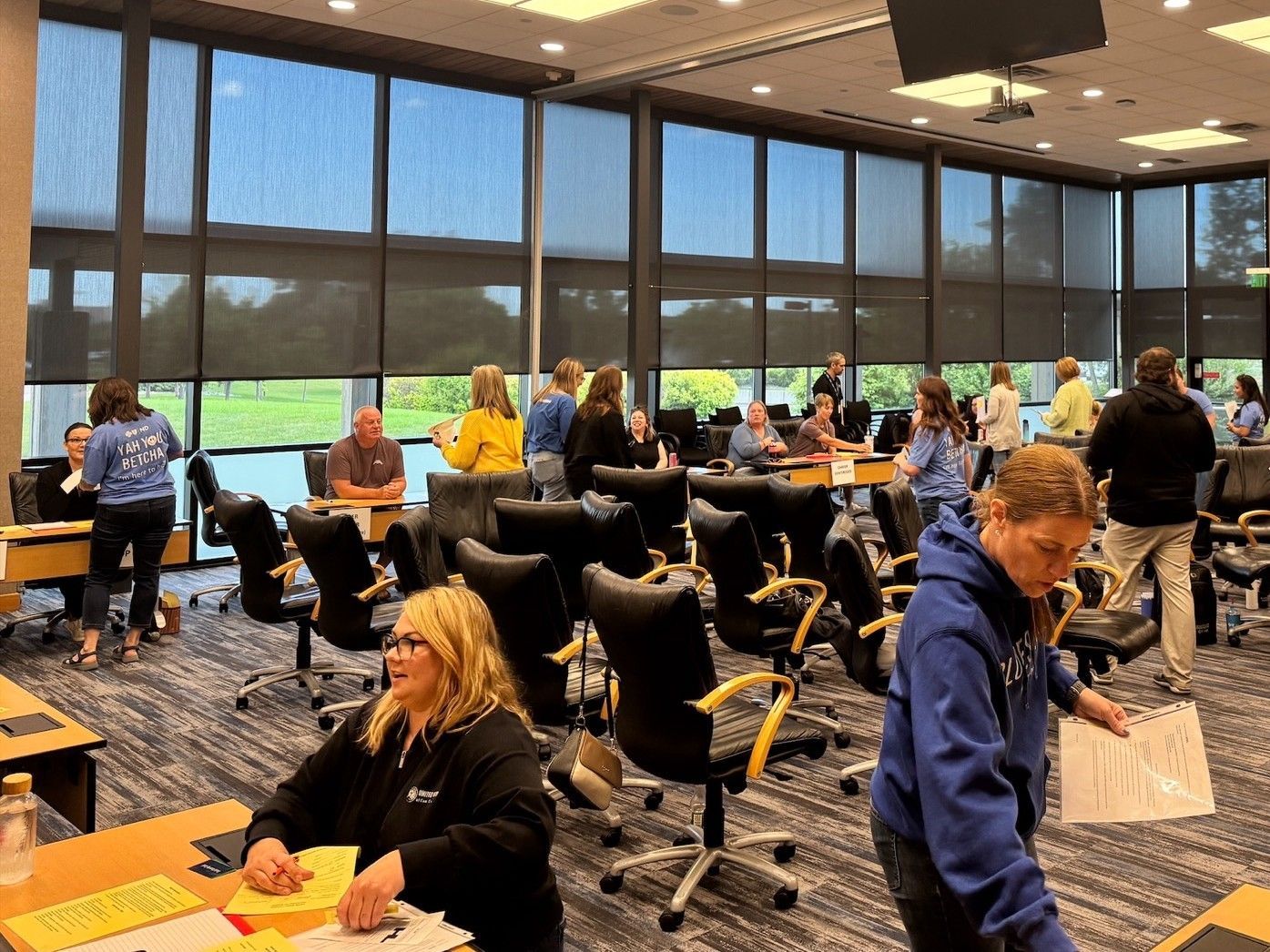
Photo from an ND DOCR Reentry Simulation Event at a Blue Cross Blue Shield of North Dakota corporate meeting in Fargo where Centre employees volunteered on June 19, 2025.
The simulation featured approximately 20 stations representing real-world locations individuals commonly must visit after release. These included the DMV, probation office, courthouse, bank, Job Service/Vocational Rehabilitation, social services, landlord office, health clinic, treatment center, bus depot, and jail. Volunteers acted as agency staff at these locations, and a few “police officers” would periodically walk around and check participants’ Life Cards to assess compliance. If participants were found to be out of compliance, even unintentionally, they were sent to jail for the remainder of that “week,” preventing them from completing other required tasks.
Between each week, participants returned to their seats for guided discussions to reflect on their experiences. Many expressed surprise at how difficult it was to complete all required tasks within the limited time and under restrictive conditions. One example frequently discussed involved a participant who needed to check in with their probation officer but lacked transportation. To obtain a bus pass, they were told they needed an ID; however, obtaining an ID required additional documentation and time. As a result, the participant missed their probation appointment and was sent to jail.
The event concluded with a final group discussion. Many participants shared that the simulation helped them better understand the cumulative effect of everyday barriers faced by individuals on supervision. Some noted that it “put judges in the shoes of people facing reentry” and highlighted the practical difficulties that may contribute to reincarceration. Others expressed differing views, suggesting the simulation did not fully account for personal accountability. Despite varying perspectives, many participants reported that the experience would influence their work moving forward, particularly by encouraging greater patience, consideration of practical interventions, and increased awareness in treatment court settings. One participant summarized the experience by stating, “I am hoping this presentation provides both insight and some level of understanding to judges who have never represented or worked with someone facing incarceration. If reentry is this hard, then we are failing as a system and need to do more.”
Liz Nesdahl
Care Coordinator
Grand Forks